fuzzy_dl_owl2.fuzzydl.parser.dl_parser_fast
Faster drop-in replacement for fuzzy_dl_owl2.fuzzydl.parser.dl_parser.DLParser.
It uses a hand-rolled tokenizer plus a deterministic recursive-descent parser.
The grammar accepted is identical to the legacy parser. All semantic actions
are reused: this module imports the DLParser class from dl_parser_clean and
invokes every _parse_* callback with a plain token list so the knowledge
base / queries are populated exactly the same way.
The file is written so that it can be compiled with Cython using
setup_dl_parser.py for an additional native-code speedup. When run as
plain Python it still parses 5-10x faster than the legacy parser because
backtracking, packrat caching and the bounded-recursion machinery are gone.
A high-performance recursive-descent parser that acts as a drop-in replacement for the legacy FuzzyDL parser by reusing semantic actions while eliminating backtracking and caching overhead.
Description
Designed as a high-speed alternative to the original implementation, this software employs a hand-rolled tokenizer combined with a deterministic recursive-descent strategy to process FuzzyDL syntax. Instead of reimplementing the logic for building the knowledge base, it imports the legacy DLParser class and invokes its semantic action callbacks with pre-processed token lists, ensuring identical behavior while drastically reducing computational overhead. The architecture eliminates the need for backtracking, packrat caching, and complex recursion limits found in the older version, resulting in a significant performance increase even when run as standard Python code. To handle large inputs efficiently, the implementation supports streaming the source text in bounded chunks, which keeps memory usage proportional to the chunk size rather than the total file size. Additionally, the code is structured to allow compilation with Cython for native-code execution, further accelerating the parsing of complex fuzzy description logic ontologies.
Attributes
Classes
Drop-in replacement for |
|
Namespace of every FuzzyDLKeyword token literal used in dispatch. |
|
Single-pass recursive descent over a pre-lexed token stream. |
Functions
|
Returns the source-text literal (spelling) that a given |
Module Contents
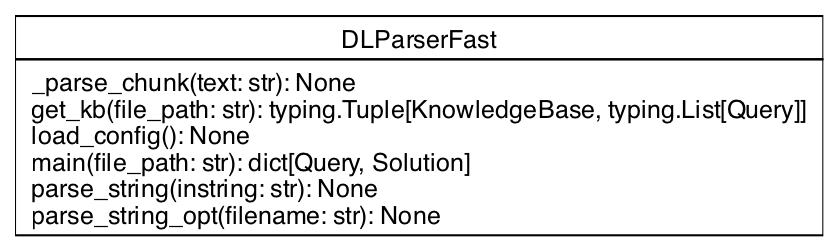
UML Class Diagram for DLParserFast
- class DLParserFast
Bases:
objectDrop-in replacement for
DLParserusing the hand-rolled parser.Public API is intentionally identical:
get_kb(),main(),parse_string(),parse_string_opt(),load_config(). The knowledge-base / queries-list class attributes live on DLParser so parse-action callbacks (which still reference DLParser.kb directly) continue to work without modification.- static _parse_chunk(text: str) None
Tokenizes the given text and parses every top-level form it contains. The token list is local, so it is reclaimed as soon as this returns — bounding peak token memory to one chunk when called by the streaming path above.
- Parameters:
text (str) – A chunk of fuzzy-DL source text to tokenize and parse.
- static get_kb(
- file_path: str,
- **kwargs: Any,
Parses a fuzzy-DL file and returns the populated knowledge base together with the list of parsed queries. This is the fast-parser mirror of
DLParser.get_kb()so callers can swap implementations without changing their call site.- Parameters:
file_path (str) – Path to the fuzzy-DL source file.
kwargs (Any) – Configuration overrides forwarded to
load_config().
- Raises:
FuzzyOntologyException – if parsing fails or the file is not found.
- Returns:
The parsed knowledge base and the list of queries.
- Return type:
Tuple[KnowledgeBase, List[Query]]
- static load_config(**kwargs: Any) None
Loads reasoner/parser configuration by delegating to
DLParser.load_config(), so the fast parser shares the exact same configuration handling as the legacy one. Any keyword overrides are forwarded unchanged; the call updates global configuration state and returns nothing.- Parameters:
kwargs (Any) – Configuration overrides forwarded to
DLParser.load_config().
- static main(
- file_path: str,
- **kwargs: Any,
Runs the full fast-parser pipeline for a fuzzy-DL file: it parses the file into a knowledge base, solves the TBox, and answers every parsed query, collecting the per-query solutions into a dictionary.
all-instancesqueries short-circuit to an informational message when the KB has no individuals. The cyclic garbage collector is disabled for the duration (and restored afterwards) since the run builds a large acyclic object graph that would otherwise be scanned repeatedly; an inconsistent ontology is reported as the answer1.0rather than propagated.
- static parse_string(instring: str) None
Parses a complete fuzzy-DL source string. The constructed knowledge base and queries are accumulated as side effects in
DLParser.kbandDLParser.queries_list; the method itself returns nothing.Small sources are tokenized and parsed in a single pass. Sources above
_STREAM_THRESHOLDare streamed form-by-form in bounded chunks so the live token set stays proportional to one chunk rather than the whole file; the resulting knowledge base is identical either way.- Parameters:
instring (str) – The fuzzy-DL source text to parse.
- static parse_string_opt(filename: str) None
Parses an entire fuzzy-DL file using the fastest available path. When the compiled re2c/flex backend is present, the file is mmap-ed and tokenized in C and parsed form-by-form so peak token memory stays bounded even for large inputs (timing is logged per chunk). Otherwise it falls back to reading the whole file into a string and delegating to
parse_string(). Parsing populates the shared knowledge base as a side effect and returns nothing.- Parameters:
filename (str) – Path to the fuzzy-DL source file to parse.
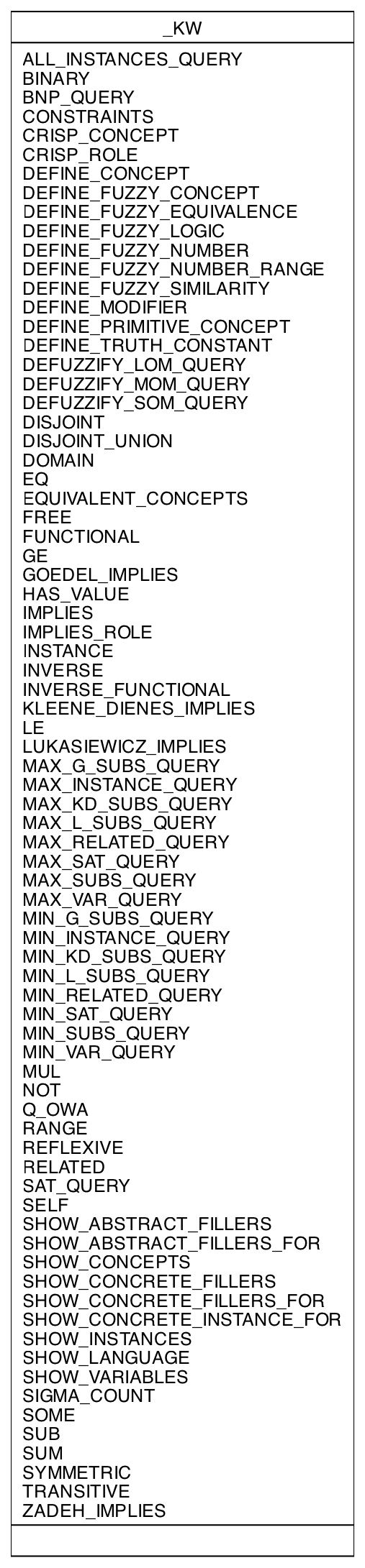
UML Class Diagram for _KW
- class _KW
Namespace of every FuzzyDLKeyword token literal used in dispatch.
- ALL_INSTANCES_QUERY
- BINARY
- BNP_QUERY
- CONSTRAINTS
- CRISP_CONCEPT
- CRISP_ROLE
- DEFINE_CONCEPT
- DEFINE_FUZZY_CONCEPT
- DEFINE_FUZZY_EQUIVALENCE
- DEFINE_FUZZY_LOGIC
- DEFINE_FUZZY_NUMBER
- DEFINE_FUZZY_NUMBER_RANGE
- DEFINE_FUZZY_SIMILARITY
- DEFINE_MODIFIER
- DEFINE_PRIMITIVE_CONCEPT
- DEFINE_TRUTH_CONSTANT
- DEFUZZIFY_LOM_QUERY
- DEFUZZIFY_MOM_QUERY
- DEFUZZIFY_SOM_QUERY
- DISJOINT
- DISJOINT_UNION
- DOMAIN
- EQ
- EQUIVALENT_CONCEPTS
- FREE
- FUNCTIONAL
- GE
- GOEDEL_IMPLIES
- HAS_VALUE
- IMPLIES
- IMPLIES_ROLE
- INSTANCE
- INVERSE
- INVERSE_FUNCTIONAL
- KLEENE_DIENES_IMPLIES
- LE
- LUKASIEWICZ_IMPLIES
- MAX_G_SUBS_QUERY
- MAX_INSTANCE_QUERY
- MAX_KD_SUBS_QUERY
- MAX_L_SUBS_QUERY
- MAX_RELATED_QUERY
- MAX_SAT_QUERY
- MAX_SUBS_QUERY
- MAX_VAR_QUERY
- MIN_G_SUBS_QUERY
- MIN_INSTANCE_QUERY
- MIN_KD_SUBS_QUERY
- MIN_L_SUBS_QUERY
- MIN_RELATED_QUERY
- MIN_SAT_QUERY
- MIN_SUBS_QUERY
- MIN_VAR_QUERY
- MUL
- NOT
- Q_OWA
- RANGE
- REFLEXIVE
- RELATED
- SAT_QUERY
- SELF
- SHOW_ABSTRACT_FILLERS
- SHOW_ABSTRACT_FILLERS_FOR
- SHOW_CONCEPTS
- SHOW_CONCRETE_FILLERS
- SHOW_CONCRETE_FILLERS_FOR
- SHOW_CONCRETE_INSTANCE_FOR
- SHOW_INSTANCES
- SHOW_LANGUAGE
- SHOW_VARIABLES
- SIGMA_COUNT
- SOME
- SUB
- SUM
- SYMMETRIC
- TRANSITIVE
- ZADEH_IMPLIES
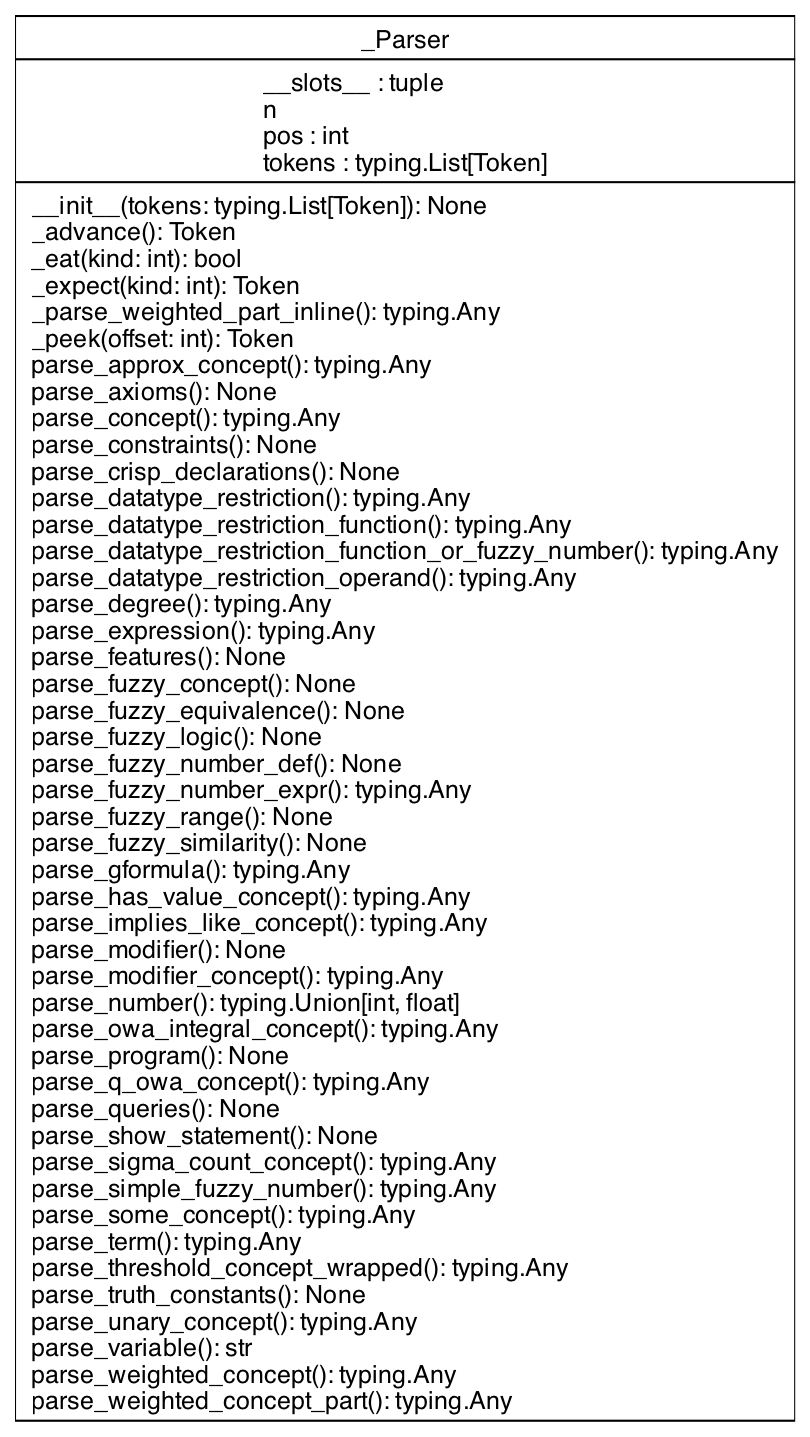
UML Class Diagram for _Parser
- class _Parser(tokens: List[fuzzy_dl_owl2.fuzzydl.parser.tokenizer.tokenizer_handler.Token])
Bases:
objectSingle-pass recursive descent over a pre-lexed token stream.
Every
parse_*method mirrors one non-terminal of the original grammar. There is no backtracking: once a method commits to a branch it consumes tokens greedily. This is safe because the fuzzy-DL grammar is LL(1) at the top level and the tokenizer has already disambiguated numbers, identifiers and punctuation.- _advance() fuzzy_dl_owl2.fuzzydl.parser.tokenizer.tokenizer_handler.Token
Consumes the current token and advances the cursor by one. The token at the old position is returned, so callers can read and step in a single call.
- Returns:
The token that was at the cursor before advancing.
- Return type:
Token
- _eat(kind: int) bool
Conditionally consumes the current token if it matches the given type code. Unlike
_expect(), a mismatch is not an error: the cursor is advanced andTruereturned only on a match, otherwise the cursor stays put andFalseis returned.- Parameters:
kind (int) – The token type code to consume if present.
- Returns:
Trueif a matching token was consumed,Falseotherwise.- Return type:
bool
- _expect(kind: int) fuzzy_dl_owl2.fuzzydl.parser.tokenizer.tokenizer_handler.Token
Requires the current token to have the given type code, consuming and returning it on a match. If the token’s kind does not match, a
FuzzyOntologyExceptionis raised with the byte offset and the offending token, and the cursor is left unmoved.- Parameters:
kind (int) – The expected token type code.
- Raises:
FuzzyOntologyException – if the current token is not of the expected kind.
- Returns:
The consumed token of the expected kind.
- Return type:
Token
- _parse_weighted_part_inline() Any
Parses an inline weighted part, matching the grammar rule
weighted_part ::= "(" number concept ")". The weight and concept are consumed and forwarded as a flat list.- Returns:
The parsed weighted part.
- Return type:
Any
- _peek(offset: int = 0) fuzzy_dl_owl2.fuzzydl.parser.tokenizer.tokenizer_handler.Token
Returns the token at
pos + offsetwithout advancing the cursor. Lookahead past the end of the stream is clamped to the last token (the EOF sentinel), so callers can peek freely without bounds checks.- Parameters:
offset (int) – How many tokens ahead of the current position to look.
- Returns:
The token at the requested position, or the final token if out of range.
- Return type:
Token
- parse_approx_concept() Any
Parses an approximation concept, matching the grammar rule
approx_concept ::= "(" approx_op role concept ")". The approximation operator, role, and inner concept are consumed and forwarded as a flat list.- Returns:
The parsed approximation concept.
- Return type:
Any
- parse_axioms() None
Parses an axiom, matching the grammar rule covering instance assertions, role assertions, implications, concept definitions, equivalent concepts, disjoint unions, range/domain declarations, role characteristics, and inverse role declarations. The keyword after
(selects the branch; the branch-specific tokens are consumed and forwarded as a flat list toDLParser._parse_axioms.- Raises:
FuzzyOntologyException – if the axiom keyword is unrecognised.
- parse_concept() Any
- concept ::=
variable
“top” | “bottom”“(” datatype_restriction “)”“(” number concept “)” – weighted part“(” “[” (“<=” | “>=”) number|variable “]” concept “)”“(” binary_connective concept+ “)”“(” “some” role (concept | variable) “)”“(” “has-value” role individual “)”“(” approx_op role concept “)”“(” “not” concept “)”“(” “self” variable “)”“(” weighted_op weighted_part+ “)”“(” “q-owa” variable concept+ “)”“(” owa_integral_op “(” number+ “)” “(” concept+ “)” “)”“(” “sigma-count” role concept “{” individual* “}” fuzzy_name “)”“(” modifier_name concept “)”Dispatches on the leading token (a bare identifier yields a variable / top / bottom; otherwise the keyword after
(selects the concept sub-parser) and consumes the whole concept form.- Raises:
FuzzyOntologyException – if the tokens do not form a valid concept.
- Returns:
The parsed concept node.
- Return type:
Any
- parse_constraints() None
constraints ::= “(” “constraints”
( “(” (“binary” | “free”) variable “)” | “(” expression cmp_op number “)” )+
“)”
- parse_crisp_declarations() None
crisp_declarations ::= “(” (“crisp-concept” | “crisp-role”) name+ “)”
- parse_datatype_restriction() Any
Parses a datatype restriction, matching the grammar rule
datatype_restriction ::= "(" cmp_op role (fuzzy_number_expr | datatype_restriction_function | variable) ")". The comparison operator, role, and third operand are consumed and forwarded as a flat list. Feature-type dispatch forSTRINGvalues lives inDLParser._parse_datatype_restrictionso both fast and slow parsers share one source of truth.- Returns:
The parsed datatype restriction.
- Return type:
Any
- parse_datatype_restriction_function() Any
Parses a datatype restriction function, matching the grammar rule
datatype_restriction_function ::= datatype_restriction_operand ( "+" datatype_restriction_operand )*. The first operand is parsed, then a chain of+-separated operands is consumed if present. The flat operand list is forwarded to the callback.- Returns:
The parsed restriction function.
- Return type:
Any
- parse_datatype_restriction_function_or_fuzzy_number() Any
Parses a datatype-restriction function or a fuzzy number expression, disambiguating by lookahead. Uses 1-token lookahead on the token after
(to decide among:(f+ ...)/(f- ...)/(f* ...)/(f/ ...)→ fuzzy number expression(num num num)→ simple triangular fuzzy number(num [*] fn)or(fn - fn)→ datatype restriction function
- Returns:
The parsed restriction function or fuzzy number expression.
- Return type:
Any
- parse_datatype_restriction_operand() Any
Parses a datatype restriction operand, matching the grammar rule
datatype_restriction_operand ::= number | variable | "(" number ["*"] datatype_restriction_function ")" | "(" datatype_restriction_function ("-"|"+") datatype_restriction_function ")". Disambiguation is done by 1-token lookahead after the opening parenthesis.- Returns:
The parsed restriction operand.
- Return type:
Any
- parse_degree() Any
Parses a degree, matching the grammar rule
degree ::= number | expression | variable. A number becomes a numeric degree, a parenthesised expression is parsed as a degree expression, and a bare variable becomes a variable degree.- Returns:
The parsed degree.
- Return type:
Any
- parse_expression() Any
Parses a linear expression, matching the grammar rule
expression ::= term ( "+" term )*. One or more terms separated by+are consumed and forwarded as a flat list with explicit+separators inserted.- Returns:
The parsed expression.
- Return type:
Any
- parse_features() None
features ::= “(” “range” variable type_kw number* “)”
- parse_fuzzy_concept() None
fuzzy_concept ::= “(” “define-fuzzy-concept” name shape “(” (number|variable)* “)” “)”
- parse_fuzzy_equivalence() None
fuzzy_equivalence ::= “(” “define-fuzzy-equivalence” name “)”
- parse_fuzzy_logic() None
fuzzy_logic ::= “(” “define-fuzzy-logic” logic_name “)”
- parse_fuzzy_number_def() None
fuzzy_number_def ::= “(” “define-fuzzy-number” name (fuzzy_number_expr | simple_fuzzy_number) “)”
- parse_fuzzy_number_expr() Any
Parses a fuzzy number expression, matching the grammar rule
fuzzy_number_expr ::= simple_fuzzy_number | "(" ("f+"|"f*") fuzzy_number_expr+ ")" | "(" ("f-"|"f/") fuzzy_number_expr fuzzy_number_expr ")". Compound forms (f+,f*,f-,f/) are returned as raw flat lists[op, *operands]for the consuming callback to handle.- Raises:
FuzzyOntologyException – if a compound form is malformed (e.g.
f+/f*with fewer than one operand or an unknown operator).- Returns:
The parsed fuzzy number expression.
- Return type:
Any
- parse_fuzzy_range() None
fuzzy_range ::= “(” “define-fuzzy-number-range” number number “)”
- parse_fuzzy_similarity() None
fuzzy_similarity ::= “(” “define-fuzzy-similarity” name “)”
- parse_gformula() Any
Parses a top-level
gformula, matching the grammar rulegformula ::= statement | axiom | query | show_statement | concept. The first token must be(; the keyword (or number / bracket) immediately after(is peeked and the stream is dispatched to the appropriate sub-parser. The consumed form is forwarded to the correspondingDLParser._parse_*callback.- Raises:
FuzzyOntologyException – if the first token is not
(or the inner keyword is unrecognised.- Returns:
The parsed result (concept, axiom, statement, etc.) forwarded from the sub-parser.
- Return type:
Any
- parse_has_value_concept() Any
Parses a value restriction concept, matching the grammar rule
has_value_concept ::= "(" "has-value" role individual ")". The role and individual name are consumed and forwarded as a flat list.- Returns:
The parsed value restriction concept.
- Return type:
Any
- parse_implies_like_concept() Any
Parses a binary connective concept (AND, OR, IMPLIES variants), matching the grammar rule
implies_like_concept ::= "(" op concept+ ")". The operator keyword and all operand concepts are consumed and forwarded as a flat list toDLParser._parse_binary_concept.- Returns:
The parsed binary connective concept.
- Return type:
Any
- parse_modifier() None
modifier ::= “(” “define-modifier” name modifier_kind “(” number* “)” “)”
- parse_modifier_concept() Any
Parses a modifier application concept, matching the grammar rule
modifier_concept ::= "(" modifier_name concept ")". The modifier name and inner concept are consumed and forwarded as a flat list.- Returns:
The parsed modified concept.
- Return type:
Any
- parse_number() int | float
Parses a numeric literal, matching the grammar rule
number ::= [+-]? ( \d+ [ . \d* ] | . \d+ ) ( [eE] [+-]? \d+ )?. The current token must be a number; it is consumed and converted to anintorfloatviaDLParser._to_number.- Raises:
FuzzyOntologyException – if the current token is not a numeric literal.
- Returns:
The parsed numeric value.
- Return type:
Union[int, float]
- parse_owa_integral_concept() Any
Parses an OWA / Choquet / Sugeno / quasi-Sugeno integral concept, matching the grammar rule
owa_integral_concept ::= "(" op "(" number+ ")" "(" concept+ ")" ")". The operator keyword, the parenthesised weight list, and the parenthesised concept list are consumed and forwarded as a single flat list (the callback locates the weights/concepts boundary via element types).- Returns:
The parsed OWA-integral concept.
- Return type:
Any
- parse_program() None
program ::= gformula*
- parse_q_owa_concept() Any
Parses a quantifier-guided OWA concept, matching the grammar rule
q_owa_concept ::= "(" "q-owa" variable concept+ ")". The quantifier variable and one or more operand concepts are consumed and forwarded as a flat list.- Returns:
The parsed quantifier-guided OWA concept.
- Return type:
Any
- parse_queries() None
Parses a query, matching the grammar rule covering all query types (all-instances, satisfiability, instance / subsumption / related / variable max/min, defuzzify, and BNP). The query keyword after
(selects the branch; branch-specific arguments are consumed and forwarded as a flat list toDLParser._parse_queries.- Raises:
FuzzyOntologyException – if the query keyword is unrecognised.
- parse_show_statement() None
show_statement ::= “(” show_kw (concept | variable)* “)”
- parse_sigma_count_concept() Any
Parses a sigma-count concept, matching the grammar rule
sigma_count_concept ::= "(" "sigma-count" role concept "{" individual* "}" fuzzy_name ")". The role, concept, brace-enclosed individual list, and fuzzy name are consumed and forwarded as a flat list.- Returns:
The parsed sigma-count concept.
- Return type:
Any
- parse_simple_fuzzy_number() Any
Parses a simple fuzzy number literal, matching the grammar rule
simple_fuzzy_number ::= "(" number number number ")" | number | variable. A parenthesised triple produces a triangular fuzzy number; a bare number or variable is wrapped as a scalar fuzzy number.- Raises:
FuzzyOntologyException – if a triangular literal does not contain exactly three numbers.
- Returns:
The parsed fuzzy number literal.
- Return type:
Any
- parse_some_concept() Any
Parses an existential restriction concept, matching the grammar rule
some_concept ::= "(" "some" role (concept | variable) ")". The role and second argument (either a nested concept or a bare variable) are consumed and forwarded as a flat list.- Returns:
The parsed existential restriction concept.
- Return type:
Any
- parse_term() Any
Parses a linear term, matching the grammar rule
term ::= number | variable | "(" number "*" variable ")" | number "*" variable. Bare numbers, bare variables, and parenthesised or infixnum * varforms are consumed and forwarded as a flat list.- Returns:
The parsed term.
- Return type:
Any
- parse_threshold_concept_wrapped() Any
Parses a threshold concept wrapper, matching the grammar rule
threshold_concept_wrapped ::= "(" "[" ("<=" | ">=") number|variable "]" concept ")".The tokenizer may merge the operator and its operand into a single identifier (e.g.
>=0.4), so the method splits off the inline operator and operand before forwarding the pieces to the callback.- Raises:
FuzzyOntologyException – if a threshold operator is not found or the inline operand is malformed.
- Returns:
The parsed threshold concept.
- Return type:
Any
- parse_truth_constants() None
truth_constants ::= “(” “define-truth-constant” name number “)”
- parse_unary_concept() Any
Parses a unary concept (negation or self-restriction), matching the grammar rule
unary_concept ::= "(" "not" concept ")" | "(" "self" variable ")". The keyword after the opening parenthesis selects which form to parse.- Returns:
The parsed unary concept.
- Return type:
Any
- parse_variable() str
Parses a variable, matching the grammar rule
variable ::= identifier. The current token must be a bare identifier; it is consumed and its source text returned.- Raises:
FuzzyOntologyException – if the current token is not an identifier.
- Returns:
The variable name.
- Return type:
str
- parse_weighted_concept() Any
Parses a weighted aggregation concept, matching the grammar rule
weighted_concept ::= "(" ("w-sum-zero"|"w-sum"|"w-max"|"w-min") weighted_part+ ")". The operator keyword and one or more weighted parts are consumed and forwarded as a flat list.- Returns:
The parsed weighted aggregation concept.
- Return type:
Any
- parse_weighted_concept_part() Any
Parses a weighted concept part, matching the grammar rule
weighted_concept_part ::= "(" number concept ")". The three inner elements are consumed and forwarded to the callback as a flat list.- Returns:
The parsed weighted concept part.
- Return type:
Any
- __slots__ = ('tokens', 'pos', 'n')
- n
- pos = 0
- tokens
- _kn(k: fuzzy_dl_owl2.fuzzydl.util.constants.FuzzyDLKeyword) str
Returns the source-text literal (spelling) that a given
FuzzyDLKeywordmatches in input.- Parameters:
k (FuzzyDLKeyword) – The keyword whose literal spelling is needed.
- Returns:
The keyword’s source-text literal.
- Return type:
str
- _APPROX_KW
- _AXIOM_KW
- _CMP_KW
- _CONCEPT_OP_AND_OR_IMPL
- _FEATURE_TYPE_KW
- _FUZZY_NUMBER_OP_BIN
- _FUZZY_NUMBER_OP_PAIR
- _K
- _OWA_INTEGRAL_KW
- _QUERY_KW
- _SHOW_KW
- _STATEMENT_KW
- _WEIGHTED_KW